
 Shopping Cart -
 - Anti-hestaminic & Respiratory Drugs (21)
- Anti-inflammatory Drugs (211) +-
- Baby & Mom (1383) +-
- Baby & Mom > Bath, skin & Hair > Skin Care > wibes (54)
- Beauty (3242) +-
- Beauty > Skin Care > whitening (311)
- Chemotherapy & Immune Response (891) +-
- Chemotherapy & Immune Response > ANTI-FUNGAL (11)
- Chemotherapy & Immune Response > Chemotherapeutic Agents > Hormone Antagonists >Enzyme Inhibitors (288)
- CIRCULATORY DISTURBANCE AGENTS (24)
- Diet & Fitness Products (287) +-
- DRUG AFFECTING CENTRAL NERVOUS SYSTEM (195)
- HEMATOLOGY (44)
-
Medical Supplies (540)
+-
- Chemicals & Disinfectants (19)
- Dental Supplies (38)
- Devices & Instruments (11)
- Diabetic Supplies (146)
- General Medical Supplies (21)
- I.V & Medical Solution (0)
- Intensive Care Unit & Anesthesia Supplies (0)
- KIDNEY UNIT SUPPLIES (23)
- Lab Supplies (3)
- Miscellaneous (21)
- Neonatal Unit Supplies (0)
- Operation Room Supplies (2)
- Sanitary (5)
- Sterilization Supplies (1)
- Surgical Sutures (4)
- Syringes (3)
-
Medicines & Health (2878)
+-
- Allergy & Sinus (99)
- Children's Health Care (54)
- Cough, Cold & Flu (303)
- Digestive Health & Nausea (248)
- Ear, Nose & Throat Care (201)
- Eye Care (136)
- Feminine Care (329)
- Foot Care (12)
- Orthopaedic Appliances (1)
- Pain Relief & Management (255)
- Pill Organizer (2)
- Skin Treatments (909)
- Sleep & Snoring Aids (2)
- Support & Braces (9)
- Medicines & health > Gout releif (41)
- Natural & Organic Products (82) +-
- OTC > Analgesics > Anti-inflammatory Drugs (48)
-
Personal Care (3458)
+-
- Bath & Body (283)
- Deodorant & Anti-perspirants (192)
- Ear, Nose & Throat Care (197)
- Eye Care (139)
- Feminine Care (381)
- Foot Care (21)
- Hair Care (522)
- Home Tests & Monitorings (17)
- Incontinence (7)
- Lip Care (29)
- Massage & Relaxation (17)
- Natural & Organic Personal Care (7)
- Oral Care (95)
- Pregnancy & Fertility (69)
- Shaving & Grooming (75)
- Sun Care (89)
-
Prescription Drugs (3142)
+-
- Analgesics (194)
- Cardiovascular System (411)
- Drugs Affecting Musculoskeletal System (65)
- Drugs Used In Infections (56)
- Ear & Nose Drugs (2)
- Endocrine System (224)
- Gastrointestinal Tract (263)
- Gastrointestinal Tract > Hepatology > Liver treatment (61)
- GYNECOLOGY (2)
- Miscellaneous (11)
- NEPHROLOGY > URINARY SYSTEM > RENAL DISORDERS > URINARY TRACT DISORDERS (52)
- NEUROLOGY (243)
- Nutrients & Blood Electrolytes (2)
- Respiratory System (170)
- SKIN > NAILS > HAIR > TOPICAL PREPARATIONS (138)
- Vaccines (1)
- Prescription drugs > Cardiovascular system > Anti-hypertension drugs (255)
- Sexual Wellness (325) +-
- Vitamins & Minerals Supplements (1278) +-
Ex Tax: 400EGP
Example
You can return the product within 14 days of purchase.
ReturnsYou can return the product within 14 days of purchase.

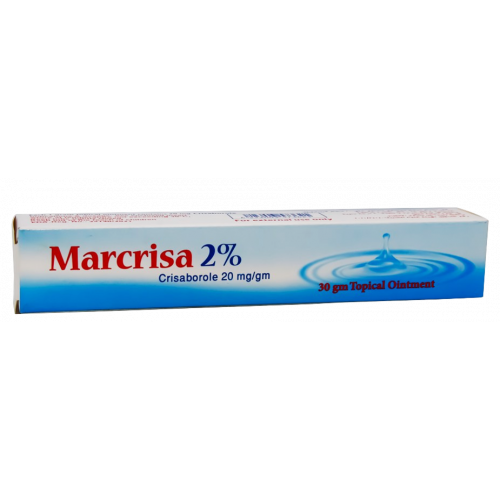
MARCRISA® 2% Topical Ointment — Crisaborole 20 mg/g
MARCRISA® 2% contains crisaborole 20 mg/g, a topical, non-steroidal anti-inflammatory medicine belonging to the phosphodiesterase-4 (PDE-4) inhibitor class. It is used for the topical treatment of mild-to-moderate atopic dermatitis (eczema). Clinical evidence demonstrates improvement in the severity of atopic dermatitis and associated itching with twice-daily application.
Composition
Each gram of ointment contains:
- Crisaborole — 20 mg
- Equivalent to Crisaborole 2% w/w
Pack size: 30 g topical ointment.
What is Crisaborole?
Crisaborole is a non-steroidal topical PDE-4 inhibitor. PDE-4 is an enzyme involved in the breakdown of intracellular cyclic adenosine monophosphate (cAMP). By inhibiting PDE-4, crisaborole increases intracellular cAMP and helps regulate inflammatory signaling pathways involved in atopic dermatitis.
Unlike topical corticosteroids, crisaborole is not a corticosteroid, making it a non-steroidal anti-inflammatory option for appropriate patients with mild-to-moderate atopic dermatitis.
Medical Uses / Indications
MARCRISA® 2% may be used for:
- Mild-to-moderate atopic dermatitis (eczema).
- Reduction of skin inflammation associated with atopic dermatitis.
- Improvement of itching (pruritus).
- Improvement of common eczema manifestations such as redness, irritation, papules and other inflammatory skin changes.
Current atopic dermatitis practice guidance considers crisaborole 2% ointment an appropriate treatment option for mild cases, although the choice of topical treatment should be individualized according to disease severity and patient factors.
Age Group
Crisaborole 2% ointment has been studied and used in patients aged 2 years and older with mild-to-moderate atopic dermatitis. Clinical studies in pediatric populations demonstrated limited systemic exposure and generally good tolerability.
How Does It Work?
Atopic dermatitis involves an abnormal inflammatory response within the skin.
Crisaborole → inhibits PDE-4 → increases intracellular cAMP → modulates inflammatory signaling → reduces skin inflammation and itching.
Because it works through the PDE-4 pathway rather than corticosteroid mechanisms, crisaborole provides a non-steroidal approach to topical anti-inflammatory treatment.
Dosage & Administration
The commonly studied and recommended regimen for crisaborole 2% is:
Apply a thin layer to affected areas twice daily.
- Apply to affected areas of the skin.
- Gently rub in until absorbed.
- Wash hands after application unless the hands themselves are being treated.
- Avoid contact with the eyes and mucous membranes.
- Use consistently as directed by the prescribing healthcare professional.
Clinical trials using twice-daily application demonstrated improvement in atopic dermatitis severity and pruritus compared with vehicle treatment.
Expected Benefits
With appropriate use, crisaborole may help:
- Reduce itching.
- Decrease redness and inflammation.
- Improve the overall severity of eczema lesions.
- Improve skin appearance and symptoms associated with mild-to-moderate atopic dermatitis.
- Provide a non-steroidal topical anti-inflammatory treatment option.
In clinical trials, improvement in pruritus was observed relatively early during treatment, with continued improvement in other signs and symptoms of atopic dermatitis.
Important Precautions
For external use only.
- Avoid getting the ointment into the eyes.
- Do not apply inside the mouth, nose or other mucous membranes.
- Do not use on areas with a known allergy to crisaborole or any component of the formulation.
- Seek medical advice if the skin condition becomes significantly worse, develops extensive crusting, pus, pain, fever or other signs suggestive of infection.
- Crisaborole is intended for atopic dermatitis and should not automatically be used for undiagnosed rashes or other skin conditions.
Possible Side Effects
The most characteristic adverse effect is application-site discomfort, particularly:
- Burning
- Stinging
- Pain or irritation at the application site
These reactions are generally localized and often mild-to-moderate. Clinical studies have generally demonstrated favorable tolerability.
If severe or persistent burning, swelling, rash or other signs of hypersensitivity develop, discontinue use and seek medical attention.
Drug Interactions
Because crisaborole is administered topically and systemic exposure is generally limited, clinically significant systemic drug interactions are not expected to be a major concern.
However, patients should inform their healthcare professional about all prescription medicines, OTC products and topical treatments being used, particularly when multiple topical products are being applied to the same area.
Use With Moisturizers
Moisturizers/emollients are an important component of atopic dermatitis management because they help support the skin barrier and reduce dryness.
Crisaborole can be incorporated into a broader eczema skin-care regimen that includes appropriate moisturization. Treatment should be individualized according to the severity and distribution of the disease. Current guidelines strongly support regular moisturizer use as part of atopic dermatitis care.
Crisaborole vs. Topical Corticosteroids
MARCRISA® is not a corticosteroid.
Its PDE-4 mechanism provides a different anti-inflammatory approach from topical corticosteroids. This can make crisaborole a useful option when a clinician wishes to use a non-steroidal topical anti-inflammatory treatment, particularly for mild-to-moderate atopic dermatitis.
However, this does not mean that crisaborole should replace topical corticosteroids in every patient. Treatment selection depends on disease severity, body site, age, previous treatment response and individual clinical circumstances.
Clinical Evidence
Randomized clinical trials have shown that crisaborole 2% ointment can improve the signs and symptoms of mild-to-moderate atopic dermatitis compared with vehicle treatment. Improvements have included overall disease severity and pruritus.
A systematic literature review and network meta-analysis found crisaborole to be associated with a greater likelihood of achieving clear or almost-clear skin compared with vehicle, with efficacy broadly comparable to some topical anti-inflammatory alternatives in the analyzed trials.
Patient Advice
- Use MARCRISA® exactly as prescribed.
- Apply only to affected skin.
- Continue regular use of a suitable moisturizer.
- Avoid scratching affected areas, as scratching can worsen inflammation and damage the skin barrier.
- Avoid known personal triggers for eczema whenever possible.
- Do not share the medication with other people.
- If symptoms fail to improve or repeatedly return, consult a dermatologist.
- Seek medical evaluation if eczema appears infected or rapidly worsens.
Patient Disclaimer
This information is provided for educational purposes only and is not a substitute for professional medical advice, diagnosis, or treatment. MARCRISA® (crisaborole 2%) should be used according to the instructions of a qualified healthcare professional. The diagnosis of atopic dermatitis should be established by an appropriate clinician, particularly when the rash is new, severe, widespread, infected, or not responding to treatment. Do not start, stop, or change treatment without consulting your doctor or pharmacist.
Selected Trusted References
- American Academy of Family Physicians (AAFP) — Updated guidelines on atopic dermatitis, including crisaborole 2% for mild disease.
- PubMed / National Library of Medicine (NIH) — Review of crisaborole 2% in mild-to-moderate atopic dermatitis.
- PubMed / NIH — Systematic literature review and network meta-analysis of crisaborole 2%.
- PubMed / NIH — Pediatric phase 1b study of crisaborole 2% and systemic exposure.
- PubMed / NIH — Mechanism and clinical development of crisaborole as a topical PDE-4 inhibitor.
Write a review
Your Name:Your Review: Note: HTML is not translated!
Rating: Bad Good
Enter the code in the box below:


