 Shopping Cart -
 - Anti-hestaminic & Respiratory Drugs (21)
- Anti-inflammatory Drugs (216) +-
- Baby & Mom (1384) +-
- Baby & Mom > Bath, skin & Hair > Skin Care > wibes (54)
- Beauty (3271) +-
- Beauty > Skin Care > whitening (306)
- Chemotherapy & Immune Response (897) +-
- Chemotherapy & Immune Response > ANTI-FUNGAL (11)
- Chemotherapy & Immune Response > Chemotherapeutic Agents > Hormone Antagonists >Enzyme Inhibitors (291)
- CIRCULATORY DISTURBANCE AGENTS (24)
- Diet & Fitness Products (285) +-
- DRUG AFFECTING CENTRAL NERVOUS SYSTEM (198)
- HEMATOLOGY (45)
-
Medical Supplies (541)
+-
- Chemicals & Disinfectants (19)
- Dental Supplies (38)
- Devices & Instruments (11)
- Diabetic Supplies (148)
- General Medical Supplies (21)
- I.V & Medical Solution (0)
- Intensive Care Unit & Anesthesia Supplies (0)
- KIDNEY UNIT SUPPLIES (23)
- Lab Supplies (3)
- Miscellaneous (21)
- Neonatal Unit Supplies (0)
- Operation Room Supplies (2)
- Sanitary (5)
- Sterilization Supplies (1)
- Surgical Sutures (4)
- Syringes (3)
-
Medicines & Health (2901)
+-
- Allergy & Sinus (101)
- Children's Health Care (54)
- Cough, Cold & Flu (308)
- Digestive Health & Nausea (249)
- Ear, Nose & Throat Care (206)
- Eye Care (136)
- Feminine Care (328)
- Foot Care (12)
- Orthopaedic Appliances (1)
- Pain Relief & Management (257)
- Pill Organizer (2)
- Skin Treatments (916)
- Sleep & Snoring Aids (2)
- Support & Braces (9)
- Medicines & health > Gout releif (41)
- Natural & Organic Products (82) +-
- OTC > Analgesics > Anti-inflammatory Drugs (48)
-
Personal Care (3471)
+-
- Bath & Body (282)
- Deodorant & Anti-perspirants (192)
- Ear, Nose & Throat Care (201)
- Eye Care (139)
- Feminine Care (379)
- Foot Care (24)
- Hair Care (526)
- Home Tests & Monitorings (17)
- Incontinence (7)
- Lip Care (29)
- Massage & Relaxation (17)
- Natural & Organic Personal Care (7)
- Oral Care (97)
- Pregnancy & Fertility (68)
- Shaving & Grooming (75)
- Sun Care (89)
-
Prescription Drugs (3209)
+-
- Analgesics (198)
- Cardiovascular System (425)
- Drugs Affecting Musculoskeletal System (65)
- Drugs Used In Infections (56)
- Ear & Nose Drugs (2)
- Endocrine System (226)
- Gastrointestinal Tract (269)
- Gastrointestinal Tract > Hepatology > Liver treatment (61)
- GYNECOLOGY (2)
- Miscellaneous (11)
- NEPHROLOGY > URINARY SYSTEM > RENAL DISORDERS > URINARY TRACT DISORDERS (52)
- NEUROLOGY (252)
- Nutrients & Blood Electrolytes (2)
- Respiratory System (174)
- SKIN > NAILS > HAIR > TOPICAL PREPARATIONS (147)
- Vaccines (1)
- Prescription drugs > Cardiovascular system > Anti-hypertension drugs (268)
- Sexual Wellness (325) +-
- Vitamins & Minerals Supplements (1290) +-
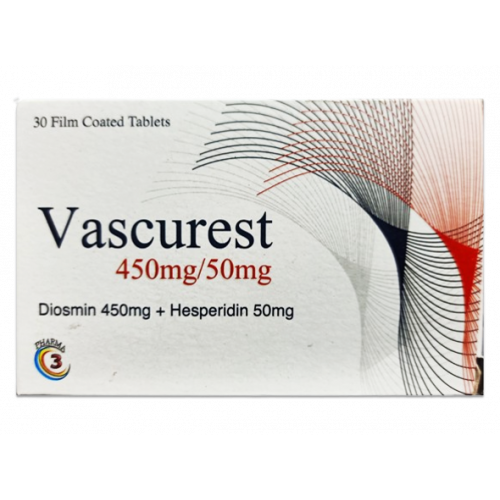
Ex Tax: 147EGP
Example
You can return the product within 14 days of purchase.
ReturnsYou can return the product within 14 days of purchase.

VASCUREST® Film-Coated Tablets
Diosmin 450 mg + Hesperidin 50 mg
Medical Description
VASCUREST® contains micronized purified flavonoid fraction (MPFF) consisting of diosmin 450 mg and hesperidin 50 mg, a well-established venoactive therapy used to improve venous tone, reduce inflammation, and protect the microcirculation. It is indicated for the management of chronic venous disease (CVD), including varicose veins, leg heaviness, edema, pain, and venous ulcers, as well as for the symptomatic treatment of acute and chronic hemorrhoidal disease.
MPFF enhances venous return by reducing venous capacitance and distensibility, improving lymphatic drainage, decreasing capillary permeability, and limiting leukocyte activation and inflammatory damage within the venous wall. These mechanisms contribute to improved venous function and symptom relief.
International guidelines from the European Society for Vascular Surgery (ESVS) and the International Union of Phlebology recognize MPFF as one of the most extensively studied and recommended oral venoactive medications for chronic venous disease.
Therapeutic Indications
VASCUREST® is indicated for:
- Chronic venous insufficiency (CVI)
- Chronic venous disease (CVD)
- Varicose veins
- Leg heaviness and fatigue
- Leg pain associated with venous disease
- Lower limb edema
- Nocturnal leg cramps related to venous insufficiency
- Venous ulcers (as an adjunct to compression therapy)
- Acute hemorrhoidal attacks
- Chronic hemorrhoidal disease
Mechanism of Action
Diosmin and hesperidin exert multiple complementary effects:
- Increases venous tone and reduces venous distensibility.
- Improves venous return to the heart.
- Enhances lymphatic drainage.
- Reduces capillary permeability and capillary fragility.
- Improves microcirculatory blood flow.
- Inhibits inflammatory mediators and leukocyte adhesion.
- Protects vascular endothelium from oxidative stress.
- Reduces tissue edema.
Clinical Benefits
Clinical studies have demonstrated that MPFF may:
- Reduce leg pain and discomfort.
- Decrease lower limb swelling.
- Improve sensations of heaviness and fatigue.
- Reduce nocturnal cramps.
- Improve quality of life in chronic venous disease.
- Accelerate healing of venous leg ulcers when combined with compression therapy.
- Shorten the duration and severity of acute hemorrhoidal episodes.
- Reduce bleeding, pain, itching, and swelling associated with hemorrhoids.
Adult Dosage
→Chronic Venous Disease
- One tablet twice daily, preferably with meals.
Some treatment regimens may later be adjusted according to physician recommendation and clinical response.
→Acute Hemorrhoidal Attack
Common regimen:
- 6 tablets daily for the first 4 days
- followed by 4 tablets daily for the next 3 days
Maintenance therapy may then continue with 2 tablets daily, depending on physician assessment.
Pediatric Use
- Not routinely recommended in children or adolescents, as adequate safety and efficacy data are limited.
- Use only if specifically prescribed by a healthcare professional.
Use During Pregnancy
- Available clinical data have not demonstrated an increased risk of congenital malformations.
- May be considered during pregnancy only when clearly needed and under physician supervision.
- Routine self-medication during pregnancy is not recommended.
Breastfeeding
Because data regarding excretion into breast milk remain limited:
- Use during breastfeeding should only occur after consultation with a healthcare provider.
Contraindications
Do not use in patients with:
- Hypersensitivity to diosmin, hesperidin, or any excipient.
Warnings and Precautions
- Compression stockings, regular walking, leg elevation, weight management, and avoidance of prolonged standing remain the cornerstone of chronic venous disease management.
- Drug therapy should complement—not replace—lifestyle measures.
- Acute hemorrhoidal symptoms that persist or worsen should be evaluated to exclude other anorectal disorders.
- Seek medical evaluation if symptoms fail to improve after appropriate treatment.
- Not intended for emergency treatment of severe venous thrombosis.
Possible Side Effects
Most adverse effects are mild and transient.
Common:
- Nausea
- Dyspepsia
- Diarrhea
- Abdominal discomfort
Less common:
- Headache
- Dizziness
- Skin rash
- Pruritus
- Urticaria
Rare:
- Allergic reactions including angioedema.
Seek immediate medical attention if severe allergic reactions occur.
Drug Interactions
Clinically significant drug interactions are uncommon.
Patients should nevertheless inform their healthcare provider about all prescription medicines, over-the-counter medications, herbal products, and dietary supplements.
Storage
- Store below 30°C.
- Protect from moisture and direct sunlight.
- Keep in the original package.
- Keep out of the reach of children.
Evidence Summary
High-quality evidence from randomized controlled trials and systematic reviews supports the use of micronized purified flavonoid fraction (MPFF) for reducing symptoms of chronic venous disease, improving quality of life, and enhancing venous ulcer healing when combined with compression therapy. Clinical trials have also demonstrated significant reductions in pain, bleeding, edema, and symptom duration during acute hemorrhoidal attacks. International vascular guidelines consistently recommend MPFF as a first-line venoactive agent for symptomatic chronic venous disease due to its favorable efficacy and safety profile.
Key Counseling Points
- Take with meals to reduce gastrointestinal discomfort.
- Continue lifestyle measures such as regular walking and leg elevation.
- Wear compression stockings if recommended.
- Maintain adequate hydration and physical activity.
- Complete the prescribed treatment course even if symptoms improve.
- Consult your physician if symptoms persist or worsen.
Patient Disclaimer
This information is intended for educational purposes only and should not replace professional medical advice. Always use VASCUREST® exactly as prescribed by your physician or pharmacist. Seek immediate medical attention if you experience severe allergic reactions, sudden leg swelling with pain, chest pain, or persistent rectal bleeding.
References
- European Society for Vascular Surgery (ESVS). 2022 Clinical Practice Guidelines on the Management of Chronic Venous Disease.
- International Union of Phlebology (UIP). Global Guidelines for Chronic Venous Disease.
- American Venous Forum (AVF) Guidelines.
- Cochrane Database of Systematic Reviews. Interventions for chronic venous insufficiency and venous leg ulcers.
- Martinez-Zapata MJ, et al. Micronized purified flavonoid fraction for chronic venous disease. Cochrane Database Syst Rev.
- Jantet G. Chronic Venous Insufficiency Study Group. MPFF in chronic venous insufficiency. Angiology.
- Guilhou JJ, et al. MPFF as adjunctive therapy in venous leg ulcer healing. Phlebology.
- Nicolaides AN. Investigation and management of chronic venous disorders. Int Angiol.
- Rabe E, et al. Management of chronic venous disease. Phlebology.
- UpToDate. Chronic venous disease and varicose veins in adults.
- Merck Manual Professional Edition. Chronic Venous Insufficiency.
- Medscape. Chronic Venous Insufficiency Treatment Review.
- U.S. National Library of Medicine (PubMed/NIH).
- National Center for Biotechnology Information (NCBI).
- University vascular medicine educational resources.
Write a review
Your Name:Your Review: Note: HTML is not translated!
Rating: Bad Good
Enter the code in the box below: