 Shopping Cart -
 - Anti-hestaminic & Respiratory Drugs (21)
- Anti-inflammatory Drugs (211) +-
- Baby & Mom (1381) +-
- Baby & Mom > Bath, skin & Hair > Skin Care > wibes (54)
- Beauty (3277) +-
- Beauty > Skin Care > whitening (306)
- Chemotherapy & Immune Response (895) +-
- Chemotherapy & Immune Response > ANTI-FUNGAL (11)
- Chemotherapy & Immune Response > Chemotherapeutic Agents > Hormone Antagonists >Enzyme Inhibitors (290)
- CIRCULATORY DISTURBANCE AGENTS (24)
- Diet & Fitness Products (285) +-
- DRUG AFFECTING CENTRAL NERVOUS SYSTEM (195)
- HEMATOLOGY (44)
-
Medical Supplies (539)
+-
- Chemicals & Disinfectants (19)
- Dental Supplies (38)
- Devices & Instruments (11)
- Diabetic Supplies (146)
- General Medical Supplies (21)
- I.V & Medical Solution (0)
- Intensive Care Unit & Anesthesia Supplies (0)
- KIDNEY UNIT SUPPLIES (23)
- Lab Supplies (3)
- Miscellaneous (21)
- Neonatal Unit Supplies (0)
- Operation Room Supplies (2)
- Sanitary (5)
- Sterilization Supplies (1)
- Surgical Sutures (4)
- Syringes (3)
-
Medicines & Health (2891)
+-
- Allergy & Sinus (100)
- Children's Health Care (54)
- Cough, Cold & Flu (306)
- Digestive Health & Nausea (250)
- Ear, Nose & Throat Care (204)
- Eye Care (135)
- Feminine Care (327)
- Foot Care (12)
- Orthopaedic Appliances (1)
- Pain Relief & Management (255)
- Pill Organizer (2)
- Skin Treatments (916)
- Sleep & Snoring Aids (2)
- Support & Braces (9)
- Medicines & health > Gout releif (41)
- Natural & Organic Products (82) +-
- OTC > Analgesics > Anti-inflammatory Drugs (48)
-
Personal Care (3475)
+-
- Bath & Body (282)
- Deodorant & Anti-perspirants (192)
- Ear, Nose & Throat Care (200)
- Eye Care (138)
- Feminine Care (379)
- Foot Care (24)
- Hair Care (529)
- Home Tests & Monitorings (17)
- Incontinence (7)
- Lip Care (29)
- Massage & Relaxation (17)
- Natural & Organic Personal Care (7)
- Oral Care (97)
- Pregnancy & Fertility (68)
- Shaving & Grooming (75)
- Sun Care (89)
-
Prescription Drugs (3179)
+-
- Analgesics (194)
- Cardiovascular System (424)
- Drugs Affecting Musculoskeletal System (65)
- Drugs Used In Infections (56)
- Ear & Nose Drugs (2)
- Endocrine System (224)
- Gastrointestinal Tract (265)
- Gastrointestinal Tract > Hepatology > Liver treatment (61)
- GYNECOLOGY (2)
- Miscellaneous (11)
- NEPHROLOGY > URINARY SYSTEM > RENAL DISORDERS > URINARY TRACT DISORDERS (52)
- NEUROLOGY (244)
- Nutrients & Blood Electrolytes (2)
- Respiratory System (171)
- SKIN > NAILS > HAIR > TOPICAL PREPARATIONS (147)
- Vaccines (1)
- Prescription drugs > Cardiovascular system > Anti-hypertension drugs (268)
- Sexual Wellness (325) +-
- Vitamins & Minerals Supplements (1282) +-
Ex Tax: 975EGP
Example
You can return the product within 14 days of purchase.
ReturnsYou can return the product within 14 days of purchase.

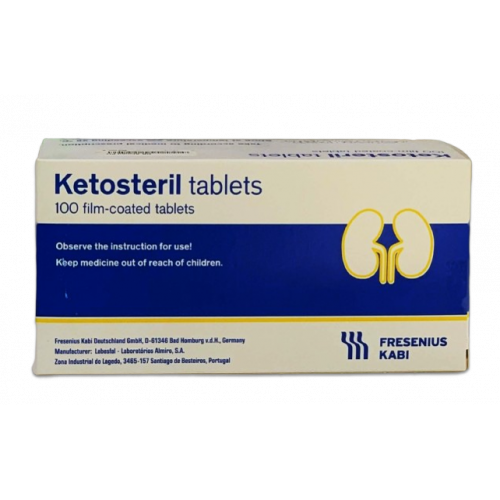
KETOSTERIL 100 FILM-COATED TABLETS
KETOSTERIL® 100 Film-Coated Tablets
Ketosteril® is a specialized oral nutritional therapy containing essential amino acids together with their nitrogen-free keto-/hydroxy-analogues. It is used as part of dietary management in selected patients with chronic kidney disease (CKD), particularly in the pre-dialysis setting, together with an appropriately prescribed protein-restricted diet.
Composition
Each film-coated tablet contains:
| Component | Amount per tablet |
|---|---|
| Calcium 3-methyl-2-oxovaleric acid — α-ketoanalogue of L-isoleucine | 67 mg |
| Calcium methyl-2-oxovaleric acid — α-ketoanalogue of L-leucine | 101 mg |
| Calcium 2-oxo-3-phenylpropionic acid — α-ketoanalogue of L-phenylalanine | 86 mg |
| Calcium 3-methyl-2-oxobutyric acid — α-ketoanalogue of L-valine | 68 mg |
| Calcium-DL-2-hydroxy-4-(methylthio)-butyric acid — α-hydroxyanalogue of L-methionine | 59 mg |
| L-Lysine acetate — equivalent to L-lysine | 75 mg L-lysine |
| L-Threonine | 23 mg |
| L-Tryptophan | 38 mg |
| L-Histidine | 30 mg |
| L-Tyrosine | Present |
| Total nitrogen | 36 mg |
| Calcium | 1.25 mmol = 50 mg |
The composition above corresponds to the formulation supplied in the product information.
What is Ketosteril®?
Ketosteril® provides selected essential amino acids and keto-/hydroxy-analogues that can participate in amino-acid synthesis while supplying comparatively little additional nitrogen. Ketoanalogues lack the amino group present in the corresponding amino acids and can be converted into amino acids within the body by incorporating nitrogen. This is the basis for their use alongside protein restriction in CKD.
Indications
Ketosteril® may be prescribed as part of the conservative nutritional management of chronic kidney disease, especially in adults with advanced CKD who are following a medically supervised protein-restricted diet.
The objectives of this approach include:
- Providing essential amino-acid precursors while limiting dietary nitrogen load.
- Supporting adequate protein nutrition during controlled protein restriction.
- Reducing the generation of nitrogenous waste products associated with protein metabolism.
- Helping manage selected metabolic complications associated with advanced CKD.
- Potentially slowing deterioration of kidney function in appropriately selected pre-dialysis patients when combined with dietary therapy.
Evidence from systematic reviews and clinical studies suggests that protein-restricted diets supplemented with ketoanalogues may delay CKD progression in some patients, although results are not uniform and the benefit depends on patient selection, dietary adherence, kidney function and overall nephrology care.
How Does It Work?
During protein restriction, reducing dietary protein also reduces the amount of essential amino acids available to the body. Ketosteril® supplies a combination of essential amino acids and corresponding keto-/hydroxy-analogues.
The ketoanalogues can be converted into their corresponding amino acids by utilizing nitrogen already present in the body. Consequently, they can help provide substrates for protein synthesis while minimizing the introduction of additional nitrogen compared with supplying the same amino acids entirely as conventional protein.
This nutritional strategy is intended to help balance:
Protein restriction → ↓ nitrogenous waste generation → nutritional amino-acid requirements maintained
Dosage & Administration
The dosage should be individualized by the nephrologist or renal dietitian according to kidney function, body weight, dietary protein intake and nutritional status.
The manufacturer's product information lists an adult dose of 4–8 tablets three times daily with meals when otherwise not prescribed differently.
The tablets should be taken during meals, as this facilitates their incorporation into metabolic pathways.
Important: Ketosteril® should not be used as a substitute for an individualized renal diet. The required protein and calorie intake should be determined by a healthcare professional.
Important Precautions
Calcium: Because each tablet supplies approximately 50 mg of calcium, excessive calcium intake or disorders associated with elevated serum calcium require medical supervision.
Hypercalcemia: Serum calcium should be monitored during treatment, particularly in patients receiving large doses or other calcium-containing products. Hypercalcemia has been reported as an adverse effect.
Adequate calories: Patients following a protein-restricted diet should maintain adequate energy intake. Insufficient calorie intake can result in utilization of body protein and nutritional deterioration.
Phenylketonuria: The formulation contains the phenylalanine analogue and may contain phenylalanine; patients with phenylketonuria (PKU) require specific medical advice before use.
Children: Use in pediatric patients requires specialist supervision because dietary protein requirements differ substantially according to age, growth and kidney function.
Advanced CKD: Dietary protein restriction should be medically supervised. Excessive restriction without appropriate nutritional monitoring can contribute to protein-energy wasting or malnutrition. KDIGO emphasizes individualized nutritional management in CKD.
Drug & Supplement Interactions
Because of its calcium content, Ketosteril® may interact with medicines whose absorption is affected by calcium-containing preparations.
In particular, separation from certain calcium-sensitive medications may be required. The product information also advises monitoring phosphate when aluminum hydroxide is administered concomitantly.
Patients should inform their physician about all prescription medicines, OTC medicines, vitamins and mineral supplements they are taking.
Possible Adverse Effects
Ketosteril® is generally used under nutritional/nephrological supervision. Potential problems include:
- Hypercalcemia, particularly with excessive calcium intake or inappropriate dosing.
- Gastrointestinal intolerance may occur in some patients.
- Other adverse effects should be assessed in the context of the patient's CKD, diet and concomitant medications.
Any symptoms suggestive of significant hypercalcemia—such as persistent nausea, vomiting, constipation, excessive thirst, frequent urination, weakness or confusion—should prompt medical assessment.
Clinical Evidence
Evidence regarding ketoanalogue supplementation is supportive but should be interpreted carefully.
A systematic review and meta-analysis found that restricted-protein diets supplemented with ketoanalogues were associated with a slower deterioration of kidney function and improvements in some metabolic parameters, without clear evidence of worsening nutritional status.
A subsequent meta-analysis of randomized and non-randomized studies also reported a potential delay in CKD progression with restricted-protein diets supplemented with ketoanalogues, particularly in certain patients with preserved residual kidney function.
However, randomized clinical evidence has not consistently demonstrated an additional benefit of very-low-protein diets plus ketoanalogues over standard low-protein diets in all patients. Therefore, Ketosteril® should be considered an adjunct to individualized nephrology and nutritional care rather than a stand-alone treatment for CKD.
Key Patient Advice
- Take Ketosteril® only according to your nephrologist's prescribed regimen.
- Follow the prescribed renal diet and protein restriction carefully.
- Do not independently increase or decrease protein intake.
- Maintain adequate calorie intake.
- Inform your physician about calcium, vitamin D, phosphate binders and other supplements.
- Regular monitoring of kidney function, calcium, phosphate and nutritional status may be required.
- Ketosteril® does not replace standard CKD treatments or dialysis when dialysis becomes medically necessary.
Patient Disclaimer
This information is provided for educational purposes only and is not a substitute for professional medical advice, diagnosis, or treatment. Ketosteril® is a specialized nutritional therapy that should be used under the supervision of a nephrologist and/or qualified renal dietitian. The appropriate dose, protein restriction and duration of treatment depend on individual kidney function, nutritional status, laboratory results and other medical conditions. Do not start, stop, or modify treatment without consulting your healthcare professional.
References
- KDIGO 2024 Clinical Practice Guideline for the Evaluation and Management of Chronic Kidney Disease — Kidney Disease: Improving Global Outcomes.
- Jiang Z, et al. Effect of restricted protein diet supplemented with keto analogues in chronic kidney disease: systematic review and meta-analysis. International Urology and Nephrology. PubMed/NIH.
- Kopple JD, et al. Is there a role for ketoacid supplements in the management of CKD? PubMed/NIH.
- Di Micco L, et al. Ketoacid Analogues Supplementation in Chronic Kidney Disease and Future Perspectives. PubMed Central/NIH.
- KDIGO CKD guideline resources — evidence-based international kidney disease guidance.
Note: The exact composition and manufacturer dosing information were cross-checked against the manufacturer's official product information, while the clinical discussion and evidence assessment above are grounded primarily in KDIGO and NIH/PubMed sources, as requested.
Write a review
Your Name:Your Review: Note: HTML is not translated!
Rating: Bad Good
Enter the code in the box below: