 Shopping Cart -
 - Anti-hestaminic & Respiratory Drugs (21)
- Anti-inflammatory Drugs (211) +-
- Baby & Mom (1382) +-
- Baby & Mom > Bath, skin & Hair > Skin Care > wibes (54)
- Beauty (3279) +-
- Beauty > Skin Care > whitening (307)
- Chemotherapy & Immune Response (895) +-
- Chemotherapy & Immune Response > ANTI-FUNGAL (11)
- Chemotherapy & Immune Response > Chemotherapeutic Agents > Hormone Antagonists >Enzyme Inhibitors (290)
- CIRCULATORY DISTURBANCE AGENTS (24)
- Diet & Fitness Products (287) +-
- DRUG AFFECTING CENTRAL NERVOUS SYSTEM (195)
- HEMATOLOGY (44)
-
Medical Supplies (539)
+-
- Chemicals & Disinfectants (19)
- Dental Supplies (38)
- Devices & Instruments (11)
- Diabetic Supplies (146)
- General Medical Supplies (21)
- I.V & Medical Solution (0)
- Intensive Care Unit & Anesthesia Supplies (0)
- KIDNEY UNIT SUPPLIES (23)
- Lab Supplies (3)
- Miscellaneous (21)
- Neonatal Unit Supplies (0)
- Operation Room Supplies (2)
- Sanitary (5)
- Sterilization Supplies (1)
- Surgical Sutures (4)
- Syringes (3)
-
Medicines & Health (2890)
+-
- Allergy & Sinus (100)
- Children's Health Care (54)
- Cough, Cold & Flu (306)
- Digestive Health & Nausea (249)
- Ear, Nose & Throat Care (204)
- Eye Care (135)
- Feminine Care (326)
- Foot Care (12)
- Orthopaedic Appliances (1)
- Pain Relief & Management (255)
- Pill Organizer (2)
- Skin Treatments (917)
- Sleep & Snoring Aids (2)
- Support & Braces (9)
- Medicines & health > Gout releif (41)
- Natural & Organic Products (82) +-
- OTC > Analgesics > Anti-inflammatory Drugs (48)
-
Personal Care (3474)
+-
- Bath & Body (282)
- Deodorant & Anti-perspirants (192)
- Ear, Nose & Throat Care (200)
- Eye Care (138)
- Feminine Care (378)
- Foot Care (24)
- Hair Care (529)
- Home Tests & Monitorings (17)
- Incontinence (7)
- Lip Care (29)
- Massage & Relaxation (17)
- Natural & Organic Personal Care (7)
- Oral Care (96)
- Pregnancy & Fertility (68)
- Shaving & Grooming (75)
- Sun Care (89)
-
Prescription Drugs (3177)
+-
- Analgesics (194)
- Cardiovascular System (424)
- Drugs Affecting Musculoskeletal System (65)
- Drugs Used In Infections (56)
- Ear & Nose Drugs (2)
- Endocrine System (224)
- Gastrointestinal Tract (264)
- Gastrointestinal Tract > Hepatology > Liver treatment (61)
- GYNECOLOGY (2)
- Miscellaneous (11)
- NEPHROLOGY > URINARY SYSTEM > RENAL DISORDERS > URINARY TRACT DISORDERS (52)
- NEUROLOGY (244)
- Nutrients & Blood Electrolytes (2)
- Respiratory System (171)
- SKIN > NAILS > HAIR > TOPICAL PREPARATIONS (147)
- Vaccines (1)
- Prescription drugs > Cardiovascular system > Anti-hypertension drugs (268)
- Sexual Wellness (325) +-
- Vitamins & Minerals Supplements (1282) +-
Ex Tax: 16,850EGP
Example
You can return the product within 14 days of purchase.
ReturnsYou can return the product within 14 days of purchase.

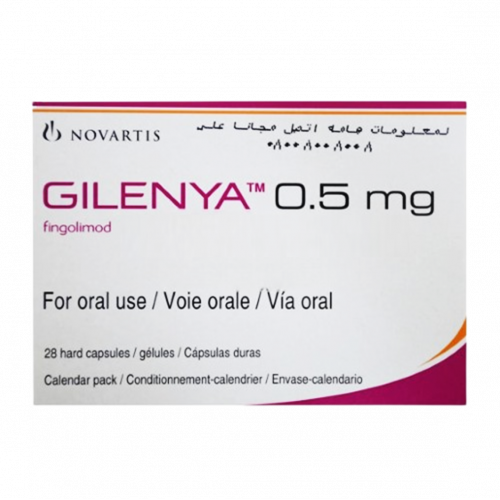
GILENYA ® 0.5 MG ( FINGOLIMOD ) 28 HARD CAPSULES
FINGOLIMOD
Product Description
Fingolimod is an oral sphingosine-1-phosphate (S1P) receptor modulator and disease-modifying therapy used primarily for relapsing forms of multiple sclerosis (MS). It reduces the circulation of certain lymphocytes, particularly T and B cells, thereby limiting their migration into the central nervous system and reducing inflammatory damage associated with MS.
Active Ingredient & Pharmacological Class
- Active ingredient: Fingolimod hydrochloride
- Therapeutic class: Immunosuppressant / selective immunomodulator
- Pharmacological class: Sphingosine-1-phosphate receptor modulator
- ATC code: L04AE01
- Dosage form: Oral hard capsules; commonly available as 0.5 mg and, in some products/populations, 0.25 mg capsules.
Mechanism of Action
Fingolimod is phosphorylated in the body to its active form, which interacts with S1P receptors on lymphocytes. This causes functional sequestration of lymphocytes within lymphoid tissues and reduces their migration into the CNS.
As a result, fewer autoreactive lymphocytes reach the brain and spinal cord, helping reduce inflammatory demyelination and disease activity in multiple sclerosis.
Indications & Clinical Uses
Fingolimod is used as a disease-modifying therapy for highly active relapsing-remitting multiple sclerosis (RRMS).
Under the current EMA indication, it is used in adults and children 10 years and older with:
- Highly active disease despite an adequate course of at least one other disease-modifying therapy; or
- Rapidly evolving severe RRMS, characterized by recurrent disabling relapses and MRI evidence of active disease.
Important: Approved indications can differ between countries and individual fingolimod products. Treatment should therefore follow the locally approved prescribing information.
Dosage & Administration
For adults, the usual recommended dose is:
Fingolimod 0.5 mg orally once daily.
The capsule may generally be taken with or without food and should be swallowed whole.
In pediatric patients, dosing is weight-dependent according to the applicable product information.
First-Dose Monitoring
Fingolimod can produce a temporary reduction in heart rate and may affect cardiac conduction when treatment is initiated. Therefore, first-dose administration requires appropriate medical monitoring, including assessment of heart rate and blood pressure and ECG monitoring according to the product-specific protocol.
Special monitoring may also be required when treatment is restarted after an interruption, depending on the duration of the interruption.
Important Warnings & Precautions
1. Bradycardia and cardiac conduction abnormalities
Fingolimod can cause bradycardia and atrioventricular conduction abnormalities, particularly following the first dose. Patients with certain pre-existing cardiac conditions or taking particular antiarrhythmic medicines require careful evaluation before treatment.
2. Infections
Because fingolimod reduces circulating lymphocytes, it can increase susceptibility to infections. A CBC should be obtained before treatment, and patients should be monitored for infection during treatment and for approximately 2 months after discontinuation.
3. Progressive Multifocal Leukoencephalopathy (PML)
Rare cases of PML have been reported. New or worsening neurological symptoms should be evaluated promptly, and fingolimod should be withheld if PML is suspected.
4. Macular edema
Fingolimod increases the risk of macular edema. A baseline ophthalmologic/fundus evaluation should be performed near treatment initiation, with follow-up approximately 3–4 months after starting treatment, periodically thereafter, and whenever visual symptoms occur. Patients with diabetes or a history of uveitis may have increased risk.
5. Liver injury
Liver enzymes should be assessed before treatment and periodically during therapy. Patients with significant hepatic impairment require particular caution and monitoring.
6. Severe disease activity after discontinuation
Stopping fingolimod can, in some patients, be followed by a severe increase in MS disease activity or disability. Treatment should not be discontinued abruptly without medical supervision and an appropriate alternative treatment plan.
7. Posterior reversible encephalopathy syndrome (PRES)
Rare cases of PRES have been reported. New-onset seizures, severe headache, altered mental status, or visual disturbances require urgent medical assessment.
8. Malignancy and skin monitoring
Fingolimod treatment has been associated with an increased risk of certain malignancies, including skin cancers. Periodic skin examination is recommended.
Common Adverse Effects
Reported adverse effects include:
- Headache
- Elevated liver transaminases
- Diarrhea
- Cough
- Influenza-like illness
- Sinusitis
- Back pain
- Abdominal pain
- Pain in the extremities
Clinically important but less common adverse effects include bradyarrhythmia, serious infections, macular edema, liver injury, PML, PRES, respiratory effects, and severe MS rebound after discontinuation.
Vaccination & Drug Interactions
- Live attenuated vaccines should generally be avoided during treatment and for 2 months after discontinuation.
- Concomitant medications that affect cardiac conduction or heart rate require careful assessment.
- Systemic ketoconazole may increase fingolimod exposure and requires monitoring.
- Before starting treatment, vaccination status—particularly immunity to varicella-zoster virus—should be assessed according to current prescribing recommendations.
Monitoring Before & During Treatment
Depending on the individual patient and local prescribing information, monitoring may include:
- CBC with differential
- Liver function tests
- Blood pressure
- Baseline ECG/cardiac assessment
- First-dose cardiac monitoring
- Ophthalmologic/fundus examination
- Assessment for infections
- Varicella-zoster immunity/vaccination status
- Periodic skin examination
- Pregnancy status when clinically appropriate
- Ongoing neurological assessment and MS disease activity monitoring
Pregnancy & Fertility
Fingolimod can cause fetal harm and requires careful pregnancy planning. Women of childbearing potential should receive appropriate counseling regarding contraception and pregnancy before and during treatment. The product-specific prescribing information should be followed regarding contraception requirements and management of pregnancy.
Patient Information
Patients should:
- Take fingolimod exactly as prescribed.
- Not stop treatment without consulting their neurologist.
- Report new visual disturbances, persistent infection symptoms, severe headache, seizures, confusion, or new neurological symptoms promptly.
- Inform healthcare professionals about all cardiovascular medicines and other immunosuppressive treatments.
- Avoid live vaccines unless specifically advised by their physician.
- Attend all required cardiac, laboratory, ophthalmologic, and neurological monitoring appointments.
Patient / Medical Disclaimer
Fingolimod is a prescription disease-modifying therapy that should be initiated and monitored by a physician experienced in the management of multiple sclerosis. This information is provided for educational purposes only and does not replace professional medical advice, diagnosis, or treatment. Do not start, stop, or change the dose of fingolimod without consulting your treating physician. Always refer to the current locally approved product information for complete prescribing, contraindication, interaction, and monitoring requirements.
References
- European Medicines Agency — Gilenya (fingolimod)
- European Medicines Agency — Fingolimod Accord
- EMA — Gilenya Product Information
- U.S. FDA — Gilenya Prescribing Information
- DailyMed — Fingolimod Prescribing Information
- FDA — Safety information regarding severe increase in disability after fingolimod discontinuation
Write a review
Your Name:Your Review: Note: HTML is not translated!
Rating: Bad Good
Enter the code in the box below: