
 Shopping Cart -
 - Anti-hestaminic & Respiratory Drugs (21)
- Anti-inflammatory Drugs (211) +-
- Baby & Mom (1383) +-
- Baby & Mom > Bath, skin & Hair > Skin Care > wibes (54)
- Beauty (3242) +-
- Beauty > Skin Care > whitening (311)
- Chemotherapy & Immune Response (891) +-
- Chemotherapy & Immune Response > ANTI-FUNGAL (11)
- Chemotherapy & Immune Response > Chemotherapeutic Agents > Hormone Antagonists >Enzyme Inhibitors (288)
- CIRCULATORY DISTURBANCE AGENTS (24)
- Diet & Fitness Products (287) +-
- DRUG AFFECTING CENTRAL NERVOUS SYSTEM (195)
- HEMATOLOGY (44)
-
Medical Supplies (540)
+-
- Chemicals & Disinfectants (19)
- Dental Supplies (38)
- Devices & Instruments (11)
- Diabetic Supplies (146)
- General Medical Supplies (21)
- I.V & Medical Solution (0)
- Intensive Care Unit & Anesthesia Supplies (0)
- KIDNEY UNIT SUPPLIES (23)
- Lab Supplies (3)
- Miscellaneous (21)
- Neonatal Unit Supplies (0)
- Operation Room Supplies (2)
- Sanitary (5)
- Sterilization Supplies (1)
- Surgical Sutures (4)
- Syringes (3)
-
Medicines & Health (2878)
+-
- Allergy & Sinus (99)
- Children's Health Care (54)
- Cough, Cold & Flu (303)
- Digestive Health & Nausea (248)
- Ear, Nose & Throat Care (201)
- Eye Care (136)
- Feminine Care (329)
- Foot Care (12)
- Orthopaedic Appliances (1)
- Pain Relief & Management (255)
- Pill Organizer (2)
- Skin Treatments (909)
- Sleep & Snoring Aids (2)
- Support & Braces (9)
- Medicines & health > Gout releif (41)
- Natural & Organic Products (82) +-
- OTC > Analgesics > Anti-inflammatory Drugs (48)
-
Personal Care (3458)
+-
- Bath & Body (283)
- Deodorant & Anti-perspirants (192)
- Ear, Nose & Throat Care (197)
- Eye Care (139)
- Feminine Care (381)
- Foot Care (21)
- Hair Care (522)
- Home Tests & Monitorings (17)
- Incontinence (7)
- Lip Care (29)
- Massage & Relaxation (17)
- Natural & Organic Personal Care (7)
- Oral Care (95)
- Pregnancy & Fertility (69)
- Shaving & Grooming (75)
- Sun Care (89)
-
Prescription Drugs (3142)
+-
- Analgesics (194)
- Cardiovascular System (411)
- Drugs Affecting Musculoskeletal System (65)
- Drugs Used In Infections (56)
- Ear & Nose Drugs (2)
- Endocrine System (224)
- Gastrointestinal Tract (263)
- Gastrointestinal Tract > Hepatology > Liver treatment (61)
- GYNECOLOGY (2)
- Miscellaneous (11)
- NEPHROLOGY > URINARY SYSTEM > RENAL DISORDERS > URINARY TRACT DISORDERS (52)
- NEUROLOGY (243)
- Nutrients & Blood Electrolytes (2)
- Respiratory System (170)
- SKIN > NAILS > HAIR > TOPICAL PREPARATIONS (138)
- Vaccines (1)
- Prescription drugs > Cardiovascular system > Anti-hypertension drugs (255)
- Sexual Wellness (325) +-
- Vitamins & Minerals Supplements (1278) +-
Ex Tax: 1,570EGP
Example
You can return the product within 14 days of purchase.
ReturnsYou can return the product within 14 days of purchase.

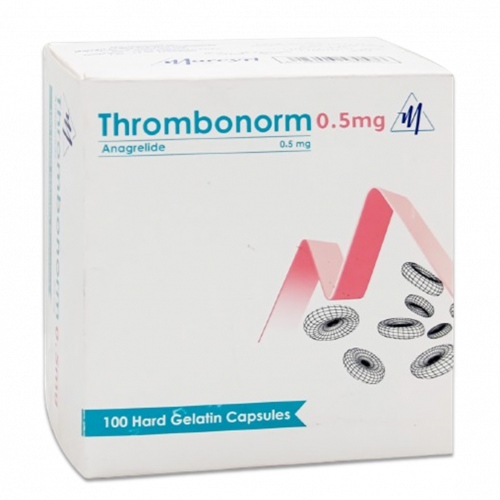
THROMBONORM® 0.5 mg Hard Gelatin Capsules
Anagrelide 0.5 mg — 100 Capsules
THROMBONORM® 0.5 mg contains anagrelide, an oral platelet-lowering medicine used primarily to reduce abnormally elevated platelet counts in patients with essential thrombocythemia (ET) and certain other myeloproliferative neoplasms. It works mainly by reducing the production and maturation of platelets from megakaryocytes in the bone marrow.
Because anagrelide can produce clinically important cardiovascular and hematological effects, treatment should be initiated and monitored by a physician experienced in managing essential thrombocythemia.
Composition
Each hard gelatin capsule contains:
- Anagrelide 0.5 mg
- — usually present as anagrelide hydrochloride/hydrochloride monohydrate, equivalent to 0.5 mg anagrelide.
What is Anagrelide?
Anagrelide is a platelet-reducing agent used to control excessive platelet production.
In essential thrombocythemia, abnormal proliferation of megakaryocytes can result in very high platelet counts. Excessive platelet counts can increase the risk of thrombotic and, paradoxically, hemorrhagic complications.
Anagrelide reduces platelet production by interfering with the maturation of megakaryocytes, the bone-marrow cells responsible for producing platelets. It is also an inhibitor of cyclic AMP phosphodiesterase III (PDE III).
Indications
Anagrelide is indicated for reducing elevated platelet counts in appropriately selected patients with essential thrombocythemia, particularly patients considered at increased risk who:
- Are intolerant of their current platelet-lowering therapy, or
- Have not achieved an acceptable platelet count with their current treatment.
Some product information defines higher-risk ET patients by factors such as:
- Age over 60 years
- Platelet count >1,000 × 10⁹/L
- Previous thrombotic or hemorrhagic events.
In the United States, anagrelide is also approved for treatment of thrombocythemia secondary to myeloproliferative neoplasms, with the objective of reducing platelet counts and associated thrombotic risk.
How Does Anagrelide Work?
Anagrelide primarily reduces the number of circulating platelets by affecting megakaryocyte development and platelet formation in the bone marrow.
Anagrelide → inhibits megakaryocyte maturation → decreases platelet production → lowers platelet count.
Its PDE-III inhibition also contributes to cardiovascular effects such as increased heart rate and contractility, which explains why cardiovascular monitoring is particularly important during therapy.
Dosage & Administration
Anagrelide dosing must be individualized according to platelet response and tolerability.
For commonly approved 0.5-mg formulations, the recommended adult starting regimen is:
1 mg/day, administered as 0.5 mg twice daily.
The dose may subsequently be adjusted according to platelet response. Dose increases should generally be gradual, with no more than 0.5 mg/day increase during a one-week period in the cited product information.
The U.S. prescribing information for Agrylin uses a different starting regimen (0.5 mg four times daily or 1 mg twice daily), illustrating that dosing recommendations can vary by regulatory labeling and clinical context.
Therefore, patients should follow the exact regimen prescribed by their hematologist and should not adjust the dose independently.
The capsules should be swallowed whole and should not be crushed or opened unless specifically instructed by the treating healthcare professional.
Monitoring During Treatment
Anagrelide requires regular laboratory and clinical monitoring.
The healthcare professional may monitor:
- Platelet count
- Hemoglobin
- White blood cell count
- Liver function — including ALT and AST
- Renal function — creatinine and urea
- Electrolytes, particularly potassium, magnesium and calcium
- Cardiovascular status
- ECG and/or echocardiography when clinically appropriate.
Platelet counts generally begin to fall within approximately 2–3 weeks after starting treatment, although the response varies between individuals.
Important Warning — Do Not Stop Abruptly
Anagrelide should not be stopped suddenly without medical supervision.
Following interruption or discontinuation, platelet counts can begin to rise within approximately 4 days and may return toward pretreatment levels within 10–14 days, sometimes exceeding the original baseline. This rebound may increase the risk of serious thrombotic complications.
If treatment needs to be stopped, the physician should determine the safest approach and monitor the platelet count.
Cardiovascular Precautions
Anagrelide can affect the cardiovascular system because of its PDE-III inhibitory activity.
Reported cardiovascular adverse effects include:
- Palpitations
- Tachycardia
- Dizziness
- Hypotension
- Arrhythmias
- Heart failure
- Cardiomyopathy
- QT prolongation
- Ventricular tachycardia
- Rarely, torsade de pointes.
Patients with existing cardiovascular disease or risk factors for QT prolongation require particular caution.
The product information recommends cardiovascular assessment before treatment, including baseline ECG, with further cardiovascular monitoring according to clinical circumstances. Electrolyte abnormalities such as low potassium or magnesium should be corrected before treatment.
Seek urgent medical attention for chest pain, fainting, severe shortness of breath, or a rapid/irregular heartbeat.
Important Contraindications & Precautions
Anagrelide may be contraindicated or unsuitable in patients with:
- Hypersensitivity to anagrelide or its ingredients.
- Moderate or severe hepatic impairment.
- Moderate or severe renal impairment; some product information specifies creatinine clearance below 50 mL/min.
Patients with mild liver or kidney impairment require an individualized assessment of potential benefits and risks.
Anagrelide should also be used cautiously in patients with:
- Cardiovascular disease
- QT prolongation or congenital long-QT syndrome
- Low potassium or magnesium
- Medicines that prolong the QT interval
- Conditions associated with pulmonary hypertension.
Possible Side Effects
Commonly reported adverse effects include:
- Headache
- Dizziness
- Palpitations
- Tachycardia
- Nausea
- Diarrhea
- Abdominal discomfort
- Fatigue
- Weakness
- Edema
- Rash.
More serious but less common reactions can include:
- Significant bleeding
- Severe thrombocytopenia
- Arrhythmias
- Heart failure
- Cardiomyopathy
- Myocardial infarction
- Pulmonary hypertension
- Pancreatitis
- Hepatic abnormalities
- Renal impairment.
Any severe or unusual symptoms should be promptly reported to the treating physician.
Drug Interactions
Anagrelide is metabolized predominantly through CYP1A2, and medicines affecting this pathway can alter anagrelide exposure.
Particular caution may be required with:
- CYP1A2 inhibitors, which may increase anagrelide exposure.
- Medicines capable of prolonging the QT interval.
- Other medicines affecting platelet function or increasing bleeding risk.
- Other drugs that influence cardiovascular function.
Because anagrelide itself affects platelet production, combining it with other antiplatelet or anticoagulant medicines may require careful assessment of the thrombotic versus bleeding risks.
Patients should provide their physician with a complete list of prescription medicines, OTC medicines, herbal products and supplements.
Pregnancy & Breastfeeding
Anagrelide should be used during pregnancy only when clearly indicated and after careful medical assessment, because adequate safety data in pregnancy are limited.
Women who are pregnant, planning pregnancy or breastfeeding should discuss treatment with their hematologist before taking anagrelide.
The decision should balance the mother's need for platelet control against potential fetal/infant risks.
Clinical Considerations in Essential Thrombocythemia
The goal of treatment is not simply to normalize the platelet count at any cost. Therapy is individualized according to the patient's thrombotic risk, bleeding risk, age, cardiovascular status, previous treatment and overall clinical condition.
Anagrelide is therefore a specialist medicine requiring:
Diagnosis → risk assessment → individualized platelet target → gradual dose adjustment → regular CBC and cardiovascular monitoring.
Patient Advice
- Take THROMBONORM® exactly as prescribed.
- Do not change the dose yourself.
- Do not discontinue treatment suddenly without medical advice.
- Attend scheduled blood tests to monitor platelet counts and other blood parameters.
- Inform your physician about heart disease, liver disease or kidney disease.
- Tell your physician if you take aspirin, anticoagulants or other medicines affecting blood clotting.
- Report unusual bruising or bleeding.
- Seek urgent medical attention for chest pain, fainting, severe breathlessness, neurological symptoms or a very rapid/irregular heartbeat.
- Keep the medicine away from children.
- Store according to the instructions on the product packaging.
Patient Disclaimer
This information is provided for educational purposes only and is not a substitute for professional medical advice, diagnosis, or treatment. THROMBONORM® (anagrelide) is a prescription hematological medicine that requires specialist supervision and regular monitoring of platelet counts and, when appropriate, cardiovascular, liver and kidney function. The correct dose varies between patients and should be determined by the treating hematologist. Do not start, stop, or modify treatment without medical advice. In case of severe bleeding, chest pain, fainting, severe shortness of breath, sudden neurological symptoms, or a rapid/irregular heartbeat, seek urgent medical attention.
References
- U.S. FDA — Agrylin (anagrelide) Prescribing Information: indication, dosage, pharmacology and safety information.
- Electronic Medicines Compendium (emc) — Anagrelide 0.5 mg SmPC: composition, indication, dosing, contraindications, cardiovascular warnings and monitoring.
- Electronic Medicines Compendium — Anagrelide Glenmark 0.5 mg SmPC: dosing and platelet-monitoring information.
- FDA current prescribing information: current regulatory safety information for anagrelide-class therapy.
Write a review
Your Name:Your Review: Note: HTML is not translated!
Rating: Bad Good
Enter the code in the box below:


