
 Shopping Cart -
- Anti-hestaminic & Respiratory Drugs
- Anti-inflammatory Drugs +-
- Baby & Mom +-
- Baby & Mom > Bath, skin & Hair > Skin Care > wibes
- Beauty +-
- Beauty > Skin Care > whitening
- Chemotherapy & Immune Response +-
- Chemotherapy & Immune Response > ANTI-FUNGAL
- Chemotherapy & Immune Response > Chemotherapeutic Agents > Hormone Antagonists >Enzyme Inhibitors
- CIRCULATORY DISTURBANCE AGENTS
- Diet & Fitness Products +-
- DRUG AFFECTING CENTRAL NERVOUS SYSTEM
- HEMATOLOGY
-
Medical Supplies
+-
- Chemicals & Disinfectants
- Dental Supplies
- Devices & Instruments
- Diabetic Supplies
- General Medical Supplies
- I.V & Medical Solution
- Intensive Care Unit & Anesthesia Supplies
- KIDNEY UNIT SUPPLIES
- Lab Supplies
- Miscellaneous
- Neonatal Unit Supplies
- Operation Room Supplies
- Sanitary
- Sterilization Supplies
- Surgical Sutures
- Syringes
- Medicines & Health +-
- Medicines & health > Gout releif
- Natural & Organic Products +-
- OTC > Analgesics > Anti-inflammatory Drugs
- Personal Care +-
-
Prescription Drugs
+-
- Analgesics
- Cardiovascular System
- Drugs Affecting Musculoskeletal System
- Drugs Used In Infections
- Ear & Nose Drugs
- Endocrine System
- Gastrointestinal Tract
- Gastrointestinal Tract > Hepatology > Liver treatment
- GYNECOLOGY
- Miscellaneous
- NEPHROLOGY > URINARY SYSTEM > RENAL DISORDERS > URINARY TRACT DISORDERS
- NEUROLOGY
- Nutrients & Blood Electrolytes
- Respiratory System
- SKIN > NAILS > HAIR > TOPICAL PREPARATIONS
- Vaccines
- Prescription drugs > Cardiovascular system > Anti-hypertension drugs
- Sexual Wellness +-
- Vitamins & Minerals Supplements +-
Ex Tax: 27EGP
Example
You can return the product within 14 days of purchase.
ReturnsYou can return the product within 14 days of purchase.

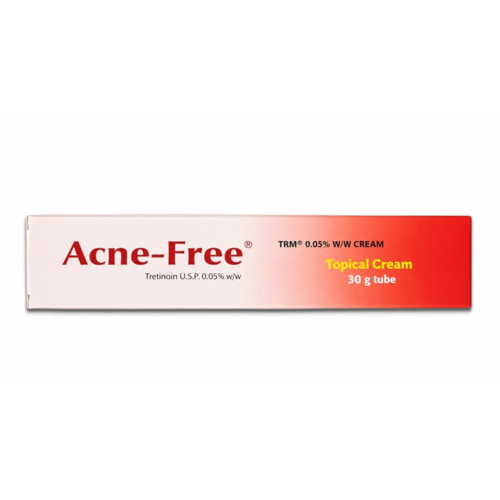
ACNE-FREE 0.05% (TRETINOIN) – TOPICAL CREAM
30 g Tube
Acne-Free 0.05% Cream contains Tretinoin 0.05% w/w, a topical retinoid derived from Vitamin A (retinoic acid), used primarily for the treatment of acne vulgaris.
Tretinoin works by regulating skin-cell turnover, preventing the accumulation of dead skin cells inside hair follicles, and reducing the formation of comedones (blackheads and whiteheads). It also helps improve skin texture and the appearance of post-acne discoloration over time.
Active ingredient: Tretinoin 0.05% w/w (0.5 mg/g).
Pharmaceutical class: Topical retinoid.
Dosage form: Topical cream.
Pack size: 30 g tube.
1. Composition
Each gram of cream contains:
- Tretinoin 0.5 mg (0.05% w/w): Active ingredient.
- Other inactive ingredients: Cream base and excipients as specified by the manufacturer.
Note: The supplied package image confirms the active ingredient and concentration but does not show the complete excipient list.
2. Mechanism of Action
Tretinoin works by modifying the growth and differentiation of skin cells through retinoic acid receptors.
Its main actions include:
A. Regulation of Skin-Cell Turnover
- Promotes the normal turnover and shedding of epidermal cells.
- Helps prevent dead skin cells from accumulating inside hair follicles.
- Reduces follicular plugging and comedone formation.
B. Comedolytic Action
- Helps eliminate existing comedones.
- Reduces the formation of new blackheads and whiteheads.
- Helps keep pores clear.
C. Anti-inflammatory Effects
- Helps reduce inflammatory processes associated with acne.
- Contributes to the improvement of acne lesions over time.
D. Skin Texture Improvement
- Promotes epidermal renewal.
- May improve uneven skin texture and the appearance of superficial post-acne discoloration with continued use.
3. Indications / Uses
Acne-Free 0.05% Cream is primarily indicated for:
- Acne Vulgaris: Treatment of mild to moderate acne, particularly comedonal acne.
- Comedonal Acne: Helps reduce blackheads and whiteheads by preventing follicular blockage.
- Inflammatory Acne: May help improve papules and pustules as part of an appropriate acne treatment regimen.
- Post-Acne Skin Texture: May improve uneven skin texture associated with acne.
- Photoaging: Tretinoin has also been studied and prescribed in specific formulations for fine wrinkles, mottled pigmentation, and other signs of photoaging; however, this is a separate indication and should not be assumed to be approved for this particular product.
4. Benefits / Therapeutic Effects
- Helps unclog pores and prevent the formation of new comedones.
- Reduces blackheads and whiteheads.
- Helps improve acne-prone skin.
- Supports the removal of dead skin cells from hair follicles.
- Helps reduce the formation of new acne lesions.
- May improve uneven skin texture associated with acne.
- Helps improve the appearance of post-acne marks over time.
- Promotes epidermal renewal and smoother-looking skin.
5. Dosage & Administration
Recommended application:
- Apply once daily, preferably at bedtime, or as directed by the dermatologist.
- Cleanse the affected skin gently using a mild, non-medicated cleanser.
- Allow the skin to dry completely before application.
- Apply a small amount in a thin layer over the entire acne-affected area, rather than treating individual pimples only.
- Avoid excessive application, as this may increase irritation without improving results.
Directions for use:
- Wash the affected area gently and pat dry.
- Allow the skin to dry thoroughly before applying the cream.
- Apply a thin layer of Acne-Free 0.05% Cream using clean fingertips.
- Spread gently and evenly over the acne-prone area.
- Wash hands after application.
- Use a suitable moisturizer to help minimize dryness and irritation.
Important instructions:
- For external use only.
- Avoid contact with the eyes, lips, corners of the nose, and mucous membranes.
- Do not apply to broken, sunburned, eczematous, or irritated skin.
- Use sunscreen with adequate SPF during the daytime.
- Avoid excessive sun exposure and tanning beds.
- Do not apply more frequently than prescribed.
Treatment duration:
- Initial improvement may become noticeable after 2–3 weeks.
- More significant results may require 6 weeks or longer of regular use.
- Some patients may experience temporary worsening of acne, redness, or peeling during the initial weeks of treatment.
- Continue treatment as directed by the dermatologist.
6. Possible Side Effects
Commonly reported local side effects include:
- Skin dryness.
- Redness (erythema).
- Peeling and flaking.
- Burning or stinging sensation.
- Itching.
- Mild skin irritation.
- Temporary worsening of acne during the initial treatment period.
- Increased sensitivity to sunlight.
Less common but potentially significant reactions:
- Severe skin irritation.
- Swelling.
- Blistering or crusting.
- Contact dermatitis.
- Changes in skin pigmentation, particularly following excessive irritation.
Important: If severe irritation develops, discontinue use temporarily and consult a dermatologist. The frequency of application may need adjustment.
7. Contraindications & Precautions
- Hypersensitivity to tretinoin or any of the cream's ingredients.
- Avoid application to broken, sunburned, irritated, or eczematous skin.
- Avoid excessive exposure to sunlight and artificial UV radiation.
- Use cautiously in patients with sensitive skin or a history of eczema.
- Avoid simultaneous use of multiple irritating topical preparations unless recommended by a dermatologist.
- Higher concentrations, including 0.05%, may cause more irritation, particularly in patients who are new to topical retinoids.
Pregnancy:
- Topical tretinoin should be avoided during pregnancy and in women planning pregnancy as a precaution.
- Discontinue use and consult a healthcare professional if pregnancy occurs during treatment.
Breastfeeding:
- Consult a healthcare professional before use.
- If prescribed, avoid applying the cream to the breast or areas that may come into direct contact with the infant.
Sun protection:
- Tretinoin-treated skin may be more susceptible to irritation from sunlight.
- Daily sunscreen use and protective clothing are recommended.
8. Drug & Topical Product Interactions
Tretinoin may interact with other topical preparations, particularly those that cause skin irritation.
Important combinations to consider:
- Benzoyl Peroxide: May oxidize and reduce the effectiveness of certain tretinoin formulations. If both are prescribed, they may need to be applied at different times of the day.
- Salicylic Acid: Concurrent use may increase skin dryness and irritation.
- Sulfur-containing preparations: May increase irritation when used together.
- Resorcinol: May increase skin irritation and peeling.
- Alcohol-based cleansers and astringents: May cause excessive dryness and irritation.
- Other topical retinoids: Concurrent use may increase irritation and is generally not recommended unless specifically prescribed.
Patients should inform their dermatologist about all topical medications, skincare products, and exfoliating treatments they use.
9. Storage
- Store at room temperature according to the manufacturer's instructions.
- Protect from excessive heat and direct sunlight.
- Keep the tube tightly closed.
- Do not freeze.
- Keep out of reach of children.
References
- U.S. National Library of Medicine – DailyMed: Tretinoin Cream 0.05% – Official prescribing information, composition, mechanism of action, indications, dosage, and precautions. DailyMed – Tretinoin 0.05% Cream.
- MedlinePlus – National Library of Medicine: Tretinoin Topical – Uses, directions for application, side effects, and precautions. MedlinePlus – Tretinoin Topical.
- American Academy of Dermatology (AAD): Acne Treatment – Dermatological recommendations for topical retinoids and acne management. AAD – Acne Treatment.
- American Academy of Dermatology (AAD): Pregnancy Skin Care – Recommendations regarding topical retinoids during pregnancy. AAD – Pregnancy Skin Care.
- U.S. Food and Drug Administration (FDA): Tretinoin Cream – Official patient instructions and safety information. FDA – Tretinoin Cream Patient Information.
Patient Disclaimer:
This information is provided for educational purposes only and is not intended to diagnose, treat, cure, or prevent any disease. Acne-Free 0.05% Cream is a topical prescription medication that should be used under medical supervision. Avoid use during pregnancy. Follow the recommended application instructions and consult a dermatologist if severe irritation, persistent side effects, or unexpected skin reactions occur. Do not apply to areas other than those recommended by your healthcare professional.
Write a review
Your Name:Your Review: (optional) Text is optional. Maximum 1,000 characters. Reviews are published automatically after validation.
Rating: Bad Good
Enter the code in the box below:


