
 Shopping Cart -
- Anti-hestaminic & Respiratory Drugs
- Anti-inflammatory Drugs +-
- Baby & Mom +-
- Baby & Mom > Bath, skin & Hair > Skin Care > wibes
- Beauty +-
- Beauty > Skin Care > whitening
- Chemotherapy & Immune Response +-
- Chemotherapy & Immune Response > ANTI-FUNGAL
- Chemotherapy & Immune Response > Chemotherapeutic Agents > Hormone Antagonists >Enzyme Inhibitors
- CIRCULATORY DISTURBANCE AGENTS
- Diet & Fitness Products +-
- DRUG AFFECTING CENTRAL NERVOUS SYSTEM
- HEMATOLOGY
-
Medical Supplies
+-
- Chemicals & Disinfectants
- Dental Supplies
- Devices & Instruments
- Diabetic Supplies
- General Medical Supplies
- I.V & Medical Solution
- Intensive Care Unit & Anesthesia Supplies
- KIDNEY UNIT SUPPLIES
- Lab Supplies
- Miscellaneous
- Neonatal Unit Supplies
- Operation Room Supplies
- Sanitary
- Sterilization Supplies
- Surgical Sutures
- Syringes
- Medicines & Health +-
- Medicines & health > Gout releif
- Natural & Organic Products +-
- OTC > Analgesics > Anti-inflammatory Drugs
- Personal Care +-
-
Prescription Drugs
+-
- Analgesics
- Cardiovascular System
- Drugs Affecting Musculoskeletal System
- Drugs Used In Infections
- Ear & Nose Drugs
- Endocrine System
- Gastrointestinal Tract
- Gastrointestinal Tract > Hepatology > Liver treatment
- GYNECOLOGY
- Miscellaneous
- NEPHROLOGY > URINARY SYSTEM > RENAL DISORDERS > URINARY TRACT DISORDERS
- NEUROLOGY
- Nutrients & Blood Electrolytes
- Respiratory System
- SKIN > NAILS > HAIR > TOPICAL PREPARATIONS
- Vaccines
- Prescription drugs > Cardiovascular system > Anti-hypertension drugs
- Sexual Wellness +-
- Vitamins & Minerals Supplements +-
Ex Tax: 2,600EGP
Example
You can return the product within 14 days of purchase.
ReturnsYou can return the product within 14 days of purchase.

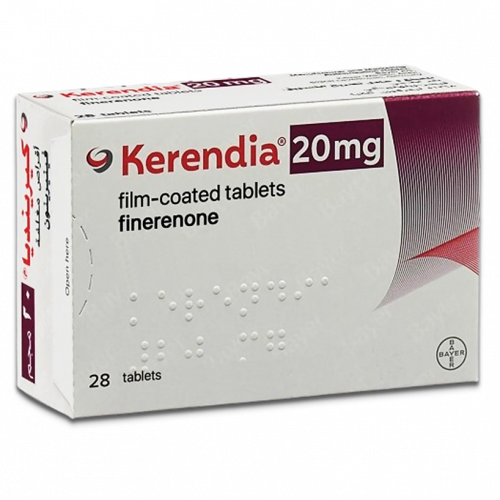
KERENDIA 20 MG (FINERENONE) – 28 FILM-COATED TABLETS
Active Ingredient: Finerenone 20 mg
Dosage Form: Film-coated tablets
Pack Size: 28 tablets
Therapeutic Category: Non-steroidal selective mineralocorticoid receptor antagonist (nsMRA).
Product Overview
Kerendia 20 mg contains finerenone, a non-steroidal, selective mineralocorticoid receptor antagonist used to reduce the risk of kidney disease progression and cardiovascular complications in eligible patients with chronic kidney disease (CKD) associated with type 2 diabetes.
Finerenone works by blocking the mineralocorticoid receptor, helping reduce harmful inflammation and fibrosis in the kidneys and cardiovascular system. Unlike steroidal mineralocorticoid receptor antagonists, finerenone has a distinct non-steroidal molecular structure and pharmacological profile.
It provides an important treatment option for eligible patients requiring additional kidney and cardiovascular risk reduction alongside standard medical management.
Active Ingredient and Mechanism of Action
Finerenone 20 mg
Finerenone is a selective, non-steroidal mineralocorticoid receptor antagonist (nsMRA).
It works by blocking the excessive activation of mineralocorticoid receptors, which play an important role in kidney and cardiovascular damage.
Its main mechanisms include:
- Reduces Inflammation: Helps limit mineralocorticoid receptor-mediated inflammatory processes in kidney and cardiovascular tissues.
- Reduces Fibrosis: Helps reduce the development of excessive scar tissue (fibrosis) in the kidneys and heart.
- Protects Kidney Function: Helps slow the progression of chronic kidney disease and reduce albuminuria (excess protein in urine).
- Cardiovascular Protection: Helps reduce the risk of cardiovascular complications, including hospitalization for heart failure, in eligible patients.
By targeting mineralocorticoid receptor overactivation, finerenone provides kidney and cardiovascular protective effects beyond conventional blood pressure management.
Indications and Benefits
Kerendia is indicated for the following conditions, according to the applicable regulatory product information:
- Chronic Kidney Disease Associated with Type 2 Diabetes: Helps reduce the risk of kidney disease progression and cardiovascular complications in adults with CKD associated with type 2 diabetes.
- Reduction of Albuminuria: Helps reduce urinary albumin levels, an important marker of kidney damage.
- Reduction in Kidney Disease Progression: Helps reduce the risk of sustained decline in kidney function and progression to end-stage kidney disease.
- Cardiovascular Risk Reduction: Helps reduce the risk of cardiovascular death, non-fatal myocardial infarction, and hospitalization for heart failure in eligible patients with CKD associated with type 2 diabetes.
- Heart Failure with Preserved or Mildly Reduced Ejection Fraction: In adults with symptomatic chronic heart failure and left ventricular ejection fraction (LVEF) of 40% or higher, finerenone helps reduce the risk of cardiovascular death and worsening heart failure events, including hospitalization and urgent heart failure visits.
►Clinical significance: Finerenone has demonstrated kidney and cardiovascular benefits in the FIDELIO-DKD and FIGARO-DKD clinical trials, while the FINEARTS-HF trial demonstrated benefits in patients with heart failure and LVEF of 40% or higher.
Dosage and Administration
Important: Kerendia is a prescription medicine. The appropriate starting dose and treatment target must be determined by the physician according to kidney function (eGFR), serum potassium levels, and the indication.
For chronic kidney disease associated with type 2 diabetes:
- Starting dose:
- eGFR ≥60 mL/min/1.73 m²: 20 mg once daily.
- eGFR ≥25 to less than 60 mL/min/1.73 m²: 10 mg once daily.
- eGFR below 25 mL/min/1.73 m²: Initiation is generally not recommended.
- Target dose: 20 mg once daily, if tolerated and laboratory results permit.
For heart failure with LVEF ≥40%:
The target dose depends on baseline kidney function and subsequent potassium and renal-function monitoring. It may be 20 mg or 40 mg once daily.
Method of administration:
- Take orally once daily, with or without food.
- Swallow the tablet whole with water.
- Take the medicine consistently at approximately the same time each day.
- If a dose is missed, take it when remembered on the same day; otherwise, skip it and resume the regular schedule the following day.
- Do not double the dose to compensate for a missed tablet.
Monitoring requirements:
- Check serum potassium and eGFR before starting treatment.
- Recheck serum potassium approximately 4 weeks after initiation and after dose adjustments.
- Continue periodic monitoring throughout treatment.
Important: The 20 mg strength is not necessarily the appropriate starting dose for every patient. Never initiate or adjust finerenone without medical supervision.
Possible Side Effects
Kerendia is generally well tolerated when used appropriately, but some patients may experience adverse effects.
Common or clinically important adverse effects:
- Hyperkalemia: Increased potassium levels in the blood, which may cause muscle weakness, abnormal heart rhythms, or potentially serious cardiac complications.
- Hypotension (low blood pressure).
- Hyponatremia (low sodium levels in the blood).
- Decreased eGFR or changes in kidney function.
- Dizziness or fatigue may occur.
►Important safety consideration:
Hyperkalemia is one of the most important risks associated with finerenone. Patients with impaired kidney function or elevated baseline potassium levels require particular attention and regular laboratory monitoring.
Seek immediate medical attention if symptoms suggest a serious electrolyte disturbance, such as severe muscle weakness, palpitations, or fainting.
Warnings and Precautions
- Potassium Monitoring: Regular monitoring of serum potassium is essential because finerenone can increase potassium levels.
- Renal Impairment: Kidney function must be assessed before and during treatment.
- Drug Interactions: Concomitant use with strong CYP3A4 inhibitors is contraindicated. Avoid strong or moderate CYP3A4 inducers.
- Potassium-Increasing Medicines: Use caution with potassium supplements, potassium-containing salt substitutes, and other medicines that increase serum potassium.
- Grapefruit: Avoid grapefruit and grapefruit juice during treatment because they may increase finerenone exposure.
- Pregnancy: Consult a physician before use; potential fetal risk should be considered.
- Breastfeeding: Breastfeeding is not recommended during treatment under the US prescribing information.
- Liver Impairment: Patients with significant hepatic impairment require careful medical assessment.
Contraindications
Kerendia should not be used in patients with:
- Hypersensitivity to finerenone or any of its excipients.
- Adrenal insufficiency.
- Concomitant treatment with strong CYP3A4 inhibitors.
- Serum potassium levels above the permitted threshold for treatment initiation.
Treatment decisions should follow the applicable local prescribing information.
Drug Interactions
Clinically significant interactions may occur with:
- Strong CYP3A4 inhibitors: Such as itraconazole, clarithromycin, and ketoconazole.
- CYP3A4 inducers: Such as rifampicin, carbamazepine, and phenytoin.
- Other potassium-raising medicines: Including potassium supplements and certain potassium-sparing diuretics.
- Grapefruit products: May increase finerenone exposure.
Patients should inform their healthcare professional about all prescription medicines, OTC products, and supplements they are taking.
Storage Conditions
- Store according to the conditions stated on the original packaging.
- Keep in the original packaging to protect the tablets.
- Keep out of reach of children.
- Do not use after the expiry date.
According to the European product information, no special storage conditions are required.
References
- U.S. Food and Drug Administration (FDA). Kerendia (Finerenone) – Full Prescribing Information, revised July 2025. Includes approved indications, dosage, contraindications, warnings, and drug interactions. FDA prescribing information.
- European Medicines Agency (EMA). Kerendia – European Public Assessment Report (EPAR). Regulatory assessment, efficacy, safety, and product information. EMA official product information.
- European Medicines Compendium (emc). Kerendia 20 mg Film-Coated Tablets – Summary of Product Characteristics, updated April 2026. Kerendia 20 mg SmPC.
- Kidney Disease: Improving Global Outcomes (KDIGO). 2024 Clinical Practice Guideline for the Evaluation and Management of Chronic Kidney Disease. Recommendations concerning non-steroidal mineralocorticoid receptor antagonists. KDIGO 2024 CKD Guideline.
- National Library of Medicine (NIH/PubMed). Official drug labeling and clinical safety information for finerenone. Finerenone clinical and prescribing information.
- DailyMed – U.S. National Library of Medicine. Kerendia (finerenone) official drug labeling. DailyMed drug information.
Patient Disclaimer
This product description is intended for educational and informational purposes only. Kerendia (finerenone) is a prescription medicine that should be used strictly under the supervision of a qualified healthcare professional. It is not intended for self-medication. Appropriate patient selection, kidney function assessment, and regular serum potassium monitoring are essential during treatment. Patients should not start, discontinue, or modify the dosage without consulting their physician. This medicine is not intended to diagnose, treat, cure, or prevent any disease without appropriate medical supervision.
Write a review
Your Name:Your Review: (optional) Text is optional. Maximum 1,000 characters. Reviews are published automatically after validation.
Rating: Bad Good
Enter the code in the box below:


